Having crowns, bridges and dentures made in Croatia and Slovenia
Dental prosthetics abroad can be an interesting way for patients from Germany, Austria and Switzerland to combine high-quality prosthetic treatment with personal support and lower costs. With several crowns, bridges or a comprehensive rehabilitation in particular, prices in German-speaking countries can add up considerably. At the same time the decision should never depend on price alone. Important criteria are the qualification of the dentist, the quality of the dental laboratory, the materials used, digital planning, the number of treatment appointments and aftercare once you are home. GO Medics helps patients compare suitable clinics in Croatia and Slovenia, organise the treatment and coordinate communication with the practitioners.
A crown, a bridge or a denture?
Dentures are basically divided into fixed and removable prosthetics. Crowns and bridges are fixed permanently in the mouth, while partial and full dentures can be taken out by the patient.
A dental crown
A crown replaces or protects the visible part of a badly damaged tooth. It can make sense where a tooth has been considerably weakened by caries, a large filling, an accident or root canal treatment. The precondition is that the root of the tooth and the surrounding tissue are sufficiently healthy and stable.
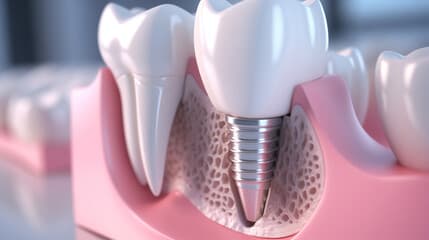
A crown can also be fixed on an implant. In that case the implant replaces the natural tooth root while the crown forms the visible part of the tooth.
A dental bridge
A bridge replaces one or more missing teeth. It is fixed to neighbouring natural teeth or to implants. With a classic bridge the neighbouring teeth serve as so-called abutment teeth. These generally have to be prepared and crowned.
Crowns are solutions for individual damaged teeth, while bridges are fixed prosthetics for closing a gap. What counts is the condition of the abutment teeth, the bite and long-term treatment planning.
A partial denture
A partial denture replaces several missing teeth where fixed prosthetics are not possible or not wanted. It can be stabilised with clasps, attachments, telescopic crowns or implants. Compared with a bridge it is removable and can be adjusted or extended if things change in the mouth.
A partial denture can be a sensible solution where several teeth are missing, the neighbouring teeth are not stable enough or implants are not an option. The exact decision should be made after an examination, X-ray diagnostics and an assessment of the gums. What materials are there?
All-ceramic
All-ceramic crowns and bridges do without a metal framework. They look particularly natural because ceramic can reflect light in a similar way to a natural tooth. They are therefore often used in the visible front region.
All-ceramic can also be suitable for back teeth. Whether the material is strong enough depends among other things on the position of the tooth, the bite, the wall thickness and any grinding of the teeth.
Zirconia
Zirconia, or zirconium oxide, is a particularly strong ceramic solution. Zirconia crowns can be made as a monolithic restoration from one material or as a zirconia framework with a ceramic veneer. They are metal-free and are often used for crowns, bridges and implant-supported prosthetics.
For crowns and bridges our partner Dentum works with computer-aided CAD/CAM production and modern 3D printing in its own laboratory. This digital manufacturing can contribute to a precise fit and to communication between dentist and dental technician that is easy to plan.
Metal-ceramic
Metal-ceramic crowns consist of a metal framework veneered with tooth-coloured ceramic. They have been established for many years and can be a functional and economical restoration. Compared with all-ceramic, however, a dark edge can become visible where the gums recede.
Metal-ceramic is not inherently inferior. It can be a suitable solution particularly in the back teeth, where strength and cost are the priority. Before treatment, however, the patient should learn which metal or alloy is used.
When can a tooth be crowned?
A tooth can be crowned where enough healthy tooth substance remains to carry the crown stably. Beforehand the dentist has to check:
- Is the tooth root stable enough?
- Is there inflammation at the root tip?
- Is the gum margin healthy?
- Is there caries under an old filling or crown?
- How much tooth substance is left?
- Is a post build-up required?
- How heavily is the tooth loaded by the opposing bite?
- Does the patient grind or clench their teeth?
With root-treated teeth a build-up can be necessary where a lot of tooth substance has been lost. A tooth with a poor prognosis should not, however, be crowned for aesthetic reasons alone. In certain cases removal and later restoration with an implant, a bridge or a denture can make more sense in the long run.

The typical course of treatment
The exact process depends on whether a single tooth, several teeth or a complete rehabilitation is planned.
Examination and planning
At the start come the clinical examination, X-rays and, in more complex cases, digital or three-dimensional diagnostics. The dentist checks the teeth, gums, bone, bite and aesthetic wishes.
Preparing the teeth
The tooth is prepared so that the crown or bridge can be fixed stably. Where there is caries or gum disease, preliminary treatment has to be carried out first. With root-treated teeth a build-up can be necessary.
An impression or a digital scan
Traditionally an impression is taken with an impression material. Many modern clinics also, or instead, work with an intraoral scanner. The digital scan records the rows of teeth and the bite and is transmitted to the dental laboratory.
A digital scan can be more comfortable for patients and makes digital manufacturing easier. Even so, the technology alone is not decisive. What matters is that the scan is carried out correctly, checked professionally and combined with a careful bite registration.
Temporary prosthetics
After the preparation the patient normally receives a temporary crown or bridge. It protects the prepared teeth, allows chewing and improves the appearance during the waiting period. Temporaries are not intended for lasting loads. Patients should avoid hard or sticky food and follow the clinic's instructions.
Try-in and adjustment
Before the final fitting, the shape, colour, margin, contact points and bite are checked. With several crowns or a bridge it is important that the prosthetics harmonise with the natural teeth and that no disturbing premature contacts arise.
Patients should not hesitate to raise questions or wishes for changes at the try-in. After the final fitting, corrections are possible but often more involved.
The final fitting
When the fit, function and appearance are right, the crown or bridge is fixed permanently. With removable prosthetics the fit is checked and the patient receives instructions on cleaning and handling.
How many appointments are needed?
For a single crown, two to three appointments are often needed depending on the laboratory and the treatment concept:
- Examination, preparation and scan or impression
- Try-in and check
- The final fitting
With several crowns or a larger bridge, additional appointments can be necessary for temporaries, bite checks and adjustments.
A partial denture too often requires more than one appointment. After the impression the laboratory produces the denture. It is then fitted and adjusted. With implant-supported prosthetics, the implant placement, the healing period and the later prosthetic restoration are added.
GO Medics, or one of our partners in dentistry, therefore tells patients before the trip how many stays are likely to be needed. With extensive rehabilitation, the treatment can be divided into several phases.
The dental laboratory and material certificates
The quality of the dental laboratory is decisive for long-term success. Patients should know:
- Does the clinic work with its own laboratory?
- Is the laboratory in Croatia, Slovenia or another country?
- Which materials are used?
- Is there a declaration of conformity?
- Are the materials used documented?
- Who is responsible for matching colour and shape?
- How is digital data stored?
- What guarantee conditions apply?
The name of a material alone is not enough, however. “Zirconia” can cover different manufacturers, qualities and processing concepts. Patients should therefore receive a written treatment plan and a detailed invoice.
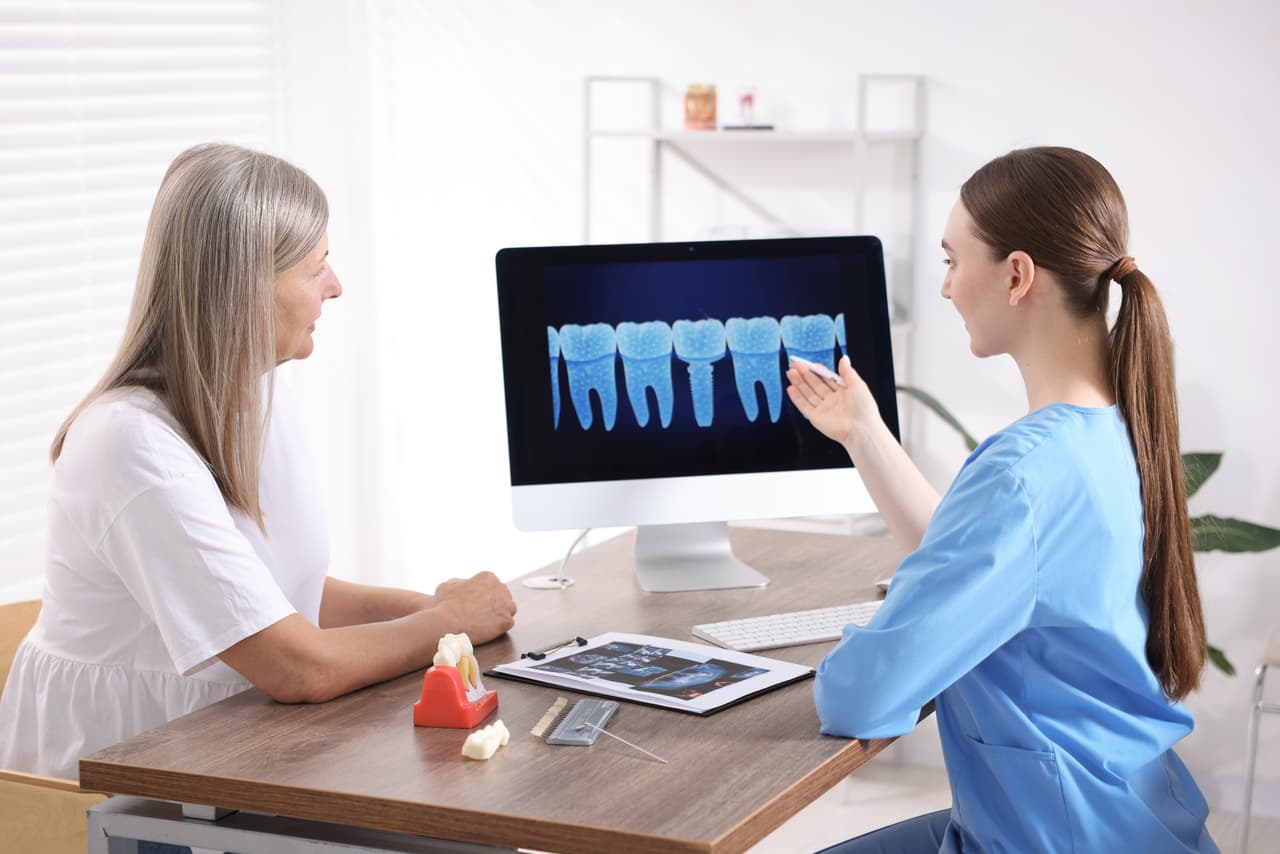
Costs per tooth and treatment unit
Prices differ according to material, clinic, laboratory, extent and individual findings. As a guide we can quote the following prices at our partners in Croatia:
- Metal-ceramic crown or bridge unit: about €280
- Zirconia ceramic crown or bridge unit: about €350
- E-max ceramic crown: about €350
- A complete acrylic denture: about €550
- A partial acrylic denture: about €400
- A high-quality full denture: about €950
In Slovenia prices are usually somewhat higher (by about 20–25%); for all-ceramic crowns they are often between €350 and €550 and for removable dentures between €600 and €1,200.
Further costs can be added to the price per crown, for example for:
- Examination and X-rays
- Removal of old crowns
- Treatment of caries
- Root canal treatment
- A post build-up
- Treatment of the gums
- Temporaries
- The impression or scan
- Try-in and later correction
- Travel, hotel and transfers
Guarantee and repairs after returning home
Before treatment it should be settled in writing how long the clinic offers a guarantee or warranty on the prosthetics. A distinction has to be made between the guarantee of the material or implant manufacturer and the responsibility of the treating clinic.
Important questions are:
- What does the guarantee cover?
- Which conditions have to be met?
- Does the patient have to come for regular check-ups?
- Who bears the travel and treatment costs for a repair?
- What applies in the case of an accident or heavy teeth grinding?
- Can adjustments be carried out at home?
- How is a complaint handled?
If there are complaints after returning home, patients should first contact the treating clinic and at the same time see a dentist at home where there is pain, inflammation, a loose crown or problems with biting. Findings, X-ray images and photos should be sent to the clinic abroad. GO Medics will help you should problems arise.
Cover by the health insurer
Patients with statutory insurance should clarify with their health insurer before treatment whether a fixed subsidy or another contribution towards the costs is possible. With extensive prosthetics, the treatment and cost plan should be submitted and approved before treatment begins.
For communication with the health insurer, a German translation, a detailed invoice, details of the materials and, where applicable, laboratory documents are helpful. The costs of travel, hotel and arrangement are normally not automatically counted as dental treatment costs.
Why professional arrangement makes sense
Treatment abroad consists of more than the actual appointment at the dental practice. Patients have to send findings, choose a clinic, coordinate appointments, plan travel, compare materials and organise aftercare.
GO Medics can support patients from Germany, Austria and Switzerland in organising these steps in a structured way. This includes communication with partner clinics in Croatia and Slovenia, coordinating consultation and treatment, support with travel planning and passing on important information about aftercare.
The medical decision of course remains with the treating dentist. Reputable arrangement does not replace an examination but helps patients find the right clinic and prepare the treatment transparently.
A checklist before booking
Before the final decision, patients should ask for and receive the following documents and information:
- A written diagnosis and treatment plan
- The name and qualification of the treating dentist
- The material and manufacturer of the crown, bridge or denture
- The number of appointments and the likely length of stay
- An exact breakdown of all costs
- Details of the temporaries
- Laboratory and material certificates
- Guarantee and repair conditions
- A contact person after returning home
- An invoice and documentation for the health insurer
- Arrangements for a change of appointment or complications
Conclusion
Crowns, bridges and dentures are among the most important areas of dental tourism, because the costs can add up quickly with several teeth or a complete rehabilitation. Croatia and Slovenia offer modern prosthetic treatment concepts, digital planning and various material options such as all-ceramic, zirconia and metal-ceramic.
The price per tooth is, however, only one part of the total cost. What counts is a precise diagnosis, a suitable choice of material, a qualified dental laboratory, realistic scheduling and clear arrangements for the guarantee and aftercare.
With the support of GO Medics, patients from German-speaking countries can plan their treatment in Croatia or Slovenia well prepared, transparently and with personal support.
Are you interested in crowns, bridges or dentures abroad? GO Medics supports you in choosing a suitable partner clinic, in communication and in organising your treatment in Croatia or Slovenia.
Interested in treatment?
Get a free consultation now