
Lens implantation for refractive errors
Intraocular lenses for glasses-free vision at all distances. Ideal from the age of 45 or with cataracts.
About the treatment
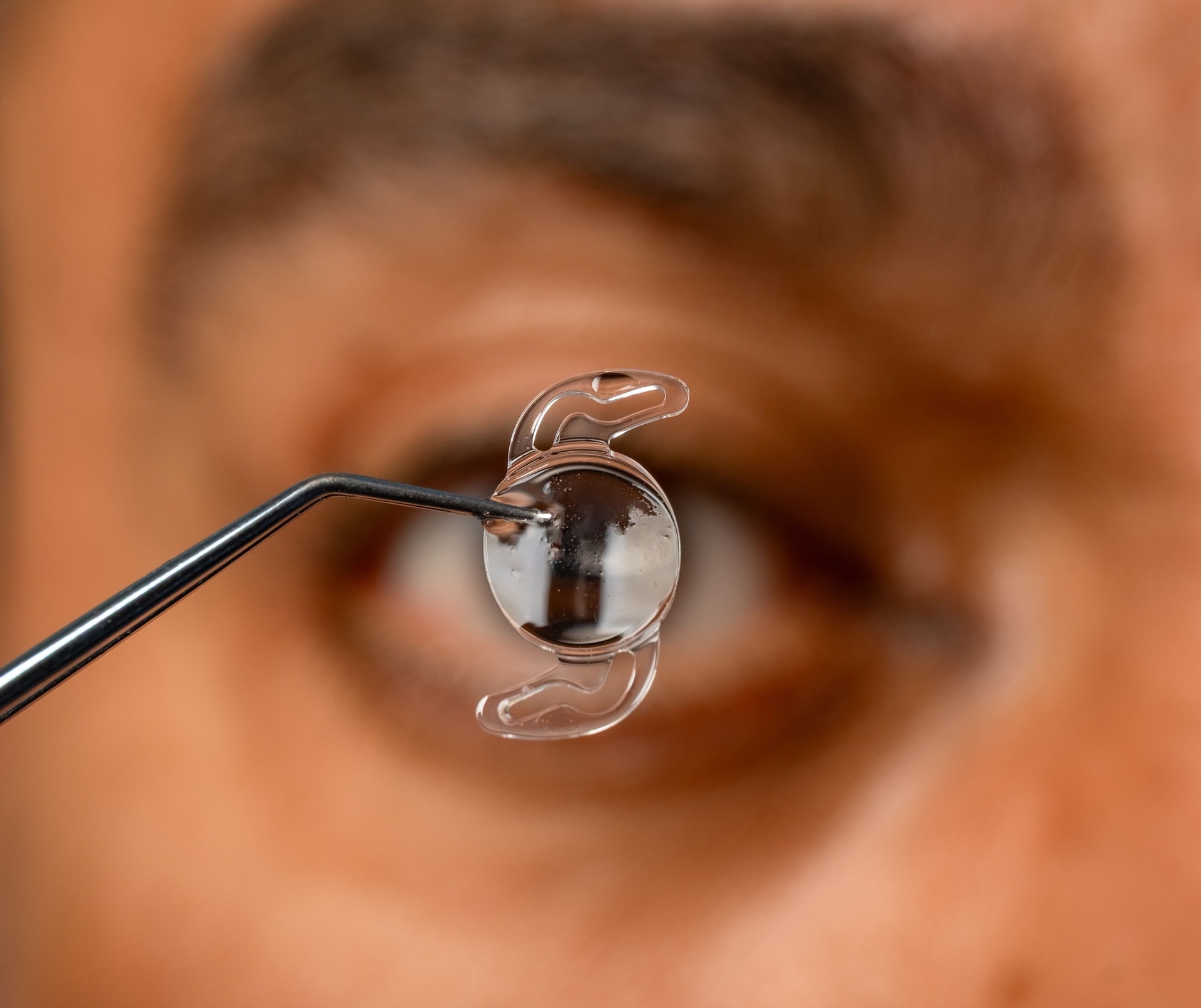
Intraocular lenses (ICL) are implantable lenses that are inserted in addition to the eye's natural lens in cases of strong refractive errors such as short-sightedness, long-sightedness or astigmatism. The natural lens is preserved, so its ability to focus near and far basically remains.
ICL implantation can be an alternative to laser eye surgery in particular, for example with high dioptre values, thin corneas or dry eyes. With pronounced age-related long-sightedness, however, it should be checked whether refractive lens exchange with a multifocal or EDOF intraocular lens is more suitable than a phakic ICL.
Your benefits
A permanent, lifelong solution – cataracts can no longer develop
One of the most important properties of intraocular lenses is their permanence: the implanted artificial lens lasts a lifetime, does not change and needs no maintenance or replacement. Because the natural lens is removed during lens implantation (refractive lens exchange), a cataract can no longer develop in the treated eye – a decisive advantage over laser eye surgery, in which the natural lens is preserved and a cataract can still develop with age. Unlike contact lenses (daily changing, cleaning) or glasses (constant dependence), the IOL offers a genuine "one operation, for life" solution.
Correction of all refractive errors in one procedure
Modern intraocular lenses can correct not just one but several refractive errors at the same time:
- Short-sightedness (myopia)
- Long-sightedness (hyperopia)
- Astigmatism
- Age-related long-sightedness (presbyopia)
- Combinations (e.g. short-sightedness + astigmatism + presbyopia)
With premium IOLs (multifocal, trifocal, EDOF), patients can often see sharply at all distances (near, intermediate, far) – without glasses or contact lenses. Studies show that up to 90% of patients with modern trifocal IOLs become completely independent of glasses.
Suitable for patients who are not suitable for LASIK
Lens implantation is an excellent alternative for patients who are not candidates for laser eye surgery (LASIK, PRK, SMILE):
- Very high dioptre values: LASIK is only suitable up to about -12 dioptres (myopia) or +5 dioptres (hyperopia) – IOLs can correct much higher values (up to -20 dioptres or more).
- Thin cornea: LASIK is not possible if the cornea is too thin – IOLs do not require corneal thickness, as no tissue is removed.
- Dry eyes: LASIK can worsen dry eye syndrome – IOLs spare the cornea and do not cause dry eyes.
- Presbyopia: LASIK cannot treat presbyopia – IOLs (multifocal, EDOF) correct age-related long-sightedness permanently.
- Early signs of cataract: With an incipient cataract, refractive lens exchange is the better choice than LASIK.
Excellent quality of vision, even at night
Modern intraocular lenses offer excellent optical quality with high contrast sharpness and minimised unwanted effects such as halos or glare at night. EDOF lenses (Extended Depth of Focus) and monofocal-plus lenses in particular offer improved night vision compared with older multifocal designs. Many patients report a clear improvement in their quality of vision compared with their previous glasses or contact lenses – especially in poor light or on long drives at night.
Quick procedure, fast recovery, reversible (with phakic IOLs)
The procedure is minimally invasive, can be performed as an outpatient under local anaesthesia and takes only 10–15 minutes per eye. Most patients already see much better the next day and can return to their normal daily activities within 1–2 days. With phakic intraocular lenses (ICL) the procedure is reversible – the lens can be removed or exchanged if necessary without damaging the eye tissue. This gives patients additional safety and flexibility, especially younger patients or those whose visual needs change.
How the treatment works
- Biometry: precise measurement of the eye to calculate the lens.
- Surgery: outpatient, 30 min., with anaesthetic eye drops. Minimally invasive incision (2 mm).
- Healing: 2–3 days of slight fluctuations in vision. Then free of glasses at all distances.
Why GO Medics?
GO Medics connects you with ISO-certified partner clinics in Croatia and Slovenia — with German-speaking support, transparent prices and personal guidance from consultation to aftercare.
Your benefits at GO Medics
Price comparison
Clinics offering this treatment
Personally vetted – we arrange the right appointment for you free of charge.

Lens implantation for refractive errors – ready to take the first step?
Free and non-binding consultation. We'll get back to you within 24 hours.